Enzyme Supplier for Cosmetic Exfoliant Manufacturing
Corneora is an enzyme supplier for cosmetic exfoliant manufacturing focused on practical formulation outcomes: controlled exfoliation feel, predictable dispersion, pH-window fit, cleaner scale-up, and documentation that supports cosmetic factory qualification.
We supply enzyme options for powder masks, enzyme cleansers, peel powders, and hybrid exfoliant systems where the enzyme must do more than sound attractive on a label. It must survive the base, process cleanly, remain elegant in the finished sensory profile, and support repeatable batch behavior.
Request a quote for papain, bromelain, lipase, or a guided enzyme comparison for your cosmetic exfoliant system.
Enzyme choices for cosmetic exfoliant systems
Papain, bromelain, and lipase are not interchangeable ingredients. Each brings a different functional profile, formulation risk, and sensory implication. Corneora helps factory teams compare the right enzyme against the real conditions of the product: water exposure, pH window, surfactant load, preservative system, fragrance, processing temperature, pack format, and target skin-feel.
| Enzyme option | Best-fit cosmetic formats | Formulation value | Key development checks |
|---|---|---|---|
| Papain | Powder masks, peel powders, dry-to-foam cleansers, hybrid exfoliant powders | Familiar protease choice for protein-targeted cosmetic exfoliation and smooth after-feel positioning | Moisture control, pH-window fit, odor management, color impact, dust handling, dispersion speed |
| Bromelain | Enzyme cleansers, powder masks, rinse-off exfoliant systems, label-forward enzyme concepts | Alternative protease profile for factories seeking a different activity curve, sensory finish, or positioning story | Compatibility with surfactants, preservation strategy, base clarity or opacity, heat exposure during processing |
| Lipase | Oil-rich cleansing systems, balm-to-milk formats, hybrid exfoliant blends, sebum-focused rinse-off concepts | Supports oil-interface performance and can complement protease-led exfoliant systems | Emollient compatibility, fragrance interaction, residual odor, emulsion stability, packaging exposure |
Built for factory chemists, not catalog browsing
Cosmetic enzyme selection becomes expensive when the ingredient is chosen before the formulation constraints are known. Corneora works from your manufacturing reality first.
We help clarify:
- pH-window suitability for rinse-off, dry, anhydrous, low-water, and water-activated formats.
- Activity consistency across lots without requiring your team to translate supplier-only test language into formulation decisions.
- Stability expectations under moisture exposure, surfactants, preservatives, fragrance, and common process stresses.
- Skin-feel direction including soft polish, clean rinse, cushion, slip, and post-rinse smoothness.
- Dispersion behavior in powder blends, creams, gels, emulsions, and cleanser bases.
- Scale-up handling including dust control, order of addition, blend uniformity, and process timing.
- Documentation readiness for qualification, technical review, and purchasing approval.
Papain for powder masks and peel powders
Papain is often the first enzyme considered for cosmetic exfoliant manufacturing because it is widely recognized and formulation-friendly when kept in the right system. It performs especially well in water-activated formats where the enzyme remains protected until consumer use.
For powder masks and peel powders, Corneora helps evaluate papain around blend uniformity, color stability, moisture sensitivity, odor profile, and the feel of the product as it hydrates on skin. The goal is not aggressive exfoliation language; it is a controlled, refined polish that fits cosmetic expectations.
Typical papain development questions include:
- Will the powder stay free-flowing through filling and storage?
- Does the enzyme disperse evenly without gritty hotspots?
- Is the pH window aligned with the reconstituted mask or cleanser?
- Does the finished product maintain a clean sensory profile?
- Can the formula be scaled without inconsistent exfoliation feel?
Bromelain for alternate protease positioning
Bromelain gives cosmetic factories another protease route when papain is not the ideal technical or positioning choice. It may be used in enzyme cleansers, masks, peel powders, and hybrid systems where a different activity curve, label story, or sensory finish is desired.
Corneora supports bromelain selection by checking compatibility with surfactants, humectants, fragrance systems, and preservation strategy. This matters in enzyme cleansers, where water exposure and daily-use expectations make stability planning more important than ingredient novelty.
Bromelain can be especially useful when your brief calls for:
- A protease-led exfoliant concept with a differentiated label story.
- A softer or cleaner rinse-off sensory target.
- A hybrid blend with acids, clays, powders, or mild surfactants.
- A controlled exfoliation experience without overbuilding the formula.
Lipase for oil-interface and hybrid exfoliant systems
Lipase is not a direct substitute for papain or bromelain. It operates at the oil interface and can support formulas where sebum-like soils, emollient balance, or oil-rich cleansing behavior are central to the concept.
In cosmetic exfoliant manufacturing, lipase is often considered as part of a hybrid system rather than a single-enzyme hero. Corneora helps teams examine whether lipase improves the formula story and processing behavior, or whether it adds unnecessary compatibility risk.
Key checks include emulsion stability, fragrance interaction, residual odor, pack exposure, and how the enzyme behaves in the chosen base. For balm, cream, milk, and oil-rich rinse-off concepts, these checks can determine whether the formula feels refined or unstable.
Format-specific supply guidance
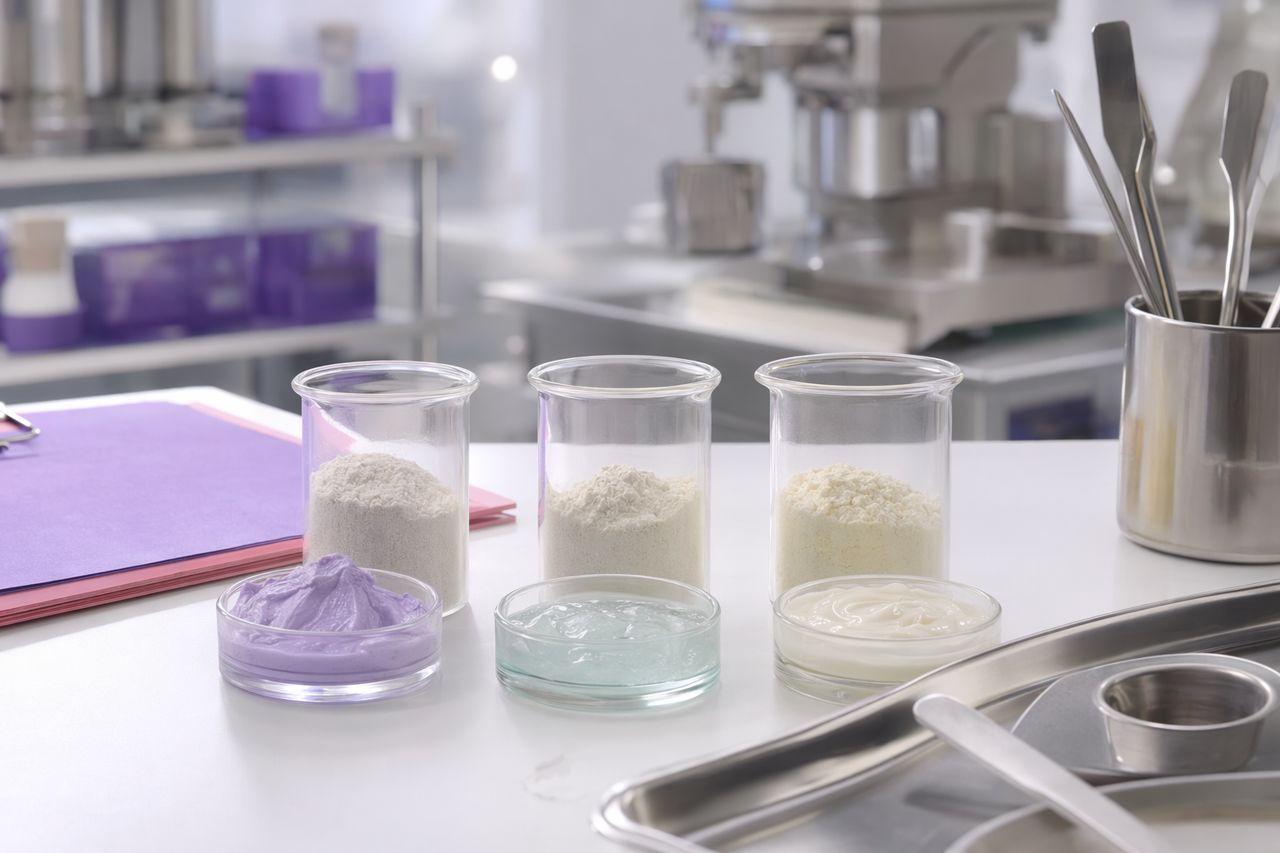
Powder masks
Dry systems protect enzyme performance until activation, but they require careful moisture management, particle compatibility, and filling behavior. Corneora supports papain and bromelain selection for powders that need smooth dispersion, elegant skin-feel, and consistent batch-to-batch performance.
Enzyme cleansers
Water-based or surfactant-containing cleansers demand tighter compatibility review. We help assess pH window, surfactant tolerance, fragrance impact, and preservation strategy so the enzyme choice supports the cleanser rather than fighting it.
Peel powders
Peel powders need a controlled activation moment. The enzyme must hydrate predictably, distribute evenly, and avoid harsh sensory cues. Corneora helps match enzyme type and grade to the powder base, consumer-use ritual, and intended finish.
Hybrid exfoliant systems
Hybrid systems may combine enzymes with acids, clays, polishing powders, surfactants, or emollients. These formulas can be beautiful, but they also create more interaction points. We help identify enzyme combinations that make technical sense before scale-up.
What Corneora provides for qualification
Cosmetic manufacturers need more than a sample. They need a supplier conversation that supports purchasing, quality, regulatory review, and production planning.
Corneora can support your project with:
- Enzyme selection guidance for papain, bromelain, lipase, or blends.
- Technical documentation appropriate for cosmetic raw material qualification.
- Practical compatibility discussion based on your base type and processing plan.
- Lot consistency expectations and supply planning.
- Sample guidance for bench evaluation and pilot-scale review.
- Quote support for commercial manufacturing volumes.
How to choose between papain, bromelain, and lipase
Use the enzyme decision to answer the formulation brief, not just the ingredient list.
Choose papain when you want a familiar protease for powder-forward, water-activated exfoliant formats with a smooth cosmetic story.
Choose bromelain when you want an alternate protease profile, a differentiated label direction, or another route to controlled rinse-off exfoliation.
Choose lipase when the formula brief involves oil-interface behavior, sebum-oriented cleansing, or a hybrid system where protease alone does not address the sensorial target.
For many factories, the right answer is not a single enzyme by name. It is the enzyme that remains compatible with the base, processes cleanly, supports the desired skin-feel, and stays repeatable at scale.
Request a quote
If you are developing a cosmetic exfoliant, enzyme cleanser, powder mask, peel powder, or hybrid exfoliant system, Corneora can help you compare papain, bromelain, and lipase against your manufacturing requirements.
Use the on-site request a quote form and include your product format, target pH window, base type, processing conditions, desired skin-feel, estimated volume, and documentation needs. We will respond with a practical supply recommendation and quote pathway for your project.
Request a quote from Corneora for cosmetic exfoliant enzyme supply.